
All-in-one platform unleashing business intelligence potential.
Fujitsu Data Intelligence PaaS

Fujitsu's approach to realizing AI for business
There are a plethora of AI applications that have proven to solve business and society challenges, turning them into opportunities to drive a more sustainable future. And with the advent of generative AI, there was exponential accessibility to boost organization's productivity.
Fujitsu Data Intelligence PaaS (DI PaaS) helps organizations realize AI today to enable faster decision-making. It can be difficult to derive meaningful insights from a vast amounts of data scattered across organizations, but not with DI Paas.
Our combination of tried and tested data and AI services couple with Professional Services will unlock more possibilities with DI Paas.
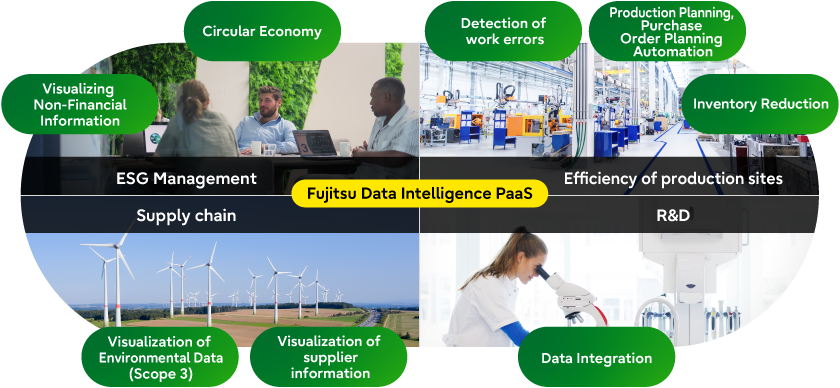
The power of DI PaaS
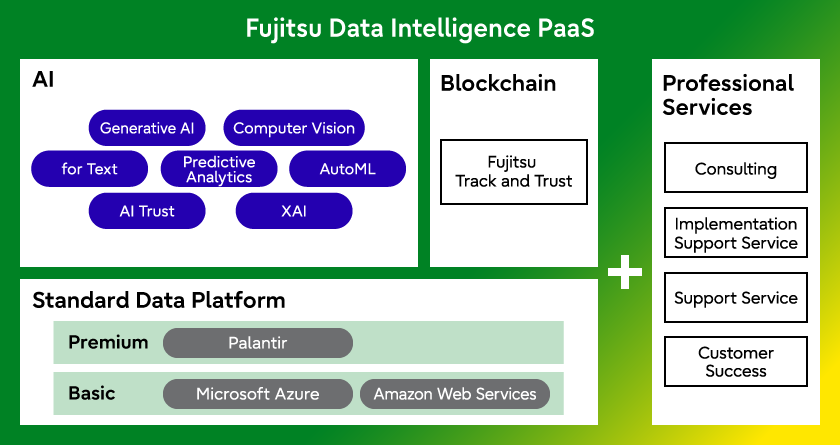
DI PaaS is a cloud-based platform that seamlessly integrates and analyzes fragmented data from various sources with the powerful combination of three platforms:
-
The world's leading AI solution to solve challenges for business and society;
-
Fujitsu Track and Trust, a blockchain solution to secure data exchange among stakeholders, paving the way for seamless collaboration and unparalleled transparency; and
-
Best of breed data platforms, leveraging partners such as Palantir, Microsoft Azure and Amazon Web Services.
Our professional services and first-class technology consulting help turn opportunities into reality.
Video Gallery
Autonomous Inventory Management with Fujitsu's AI Agent
Inventory management is becoming increasingly difficult in a supply chain that is growing more complex every day. In this video, we demonstrate how Fujitsu's AI Agent can contribute, with seven AI agents working together to perform inventory management tasks replacing human operators. Using the response to a shortage alert as an example, we will introduce the process that leads an AI agent from proposing the optimal countermeasure, to adopting and evaluating the countermeasure, and to the growth of the AI agent. By promoting data-driven business transformation, all data related to inventory operations will be made meaningful and an integrated data model will be created. If AI agents are multiplied to this end, it will be possible to quickly achieve this overwhelming improvement in productivity, work automation, and efficiency.
Dynamic Supply Chain Management optimizes inventory using Fujitsu AutoML's demand forecasting
Inventory management in manufacturing has traditionally relied heavily on human expertise and manual processes. However, rising labor costs and a growing global shortage of skilled workers are making these traditional methods insufficient for addressing emerging challenges. Innovative approaches leveraging data and AI are gaining significant traction to overcome these limitations. By predicting stock-out risks and automatically calculating optimal inventory levels, Uvance offerings are transforming supply chain efficiency. This enables manufacturers to enhance sustainability while becoming more competitive and resilient.
Decarbonization Management: Visualization of Greenhouse Gas Emissions and Strategic Simulation
Companies today face the challenge of reducing GHG emissions while maintaining profitability. This video highlights Scope 3 Category 11—emissions from the use of sold products—which is especially critical for manufacturers. It outlines a high-level view of total GHG emissions by region and product, identifying priority areas for reduction. The analysis also projects future emissions based on sales plans and evaluates the impact of factors such as sales volume and renewable energy usage. Using these insights, it simulates optimal reduction strategies that balance emission targets with profitability. Furthermore, these efforts can expand beyond Scope 3 Category 11 to include the entire supply chain through collaboration with partners. Through such initiatives, companies can pursue both sustainability and business growth.
Supply Chain Resilience: Minimizing Damage During Emergencies and Enabling Rapid Recovery
Today's supply chains face risks such as natural disasters, disruptions, and sudden demand changes. Building resilience—the ability to minimize damage and recover quickly—is essential for business continuity. This video uses a major earthquake scenario to introduce a system that rapidly assesses incident impacts and supports immediate recovery actions. During emergencies, it identifies supplier impacts and component supply risks, visualizing effects on production, customers, and financial losses. Companies can instantly understand profit and loss impacts and leverage AI‑recommended measures—such as switching to alternative suppliers—for swift response. These capabilities strengthen supply chain resilience and enable rapid business continuity.
Optimizing Hospital Management: Enhancing Visibility and Decision-Making with Data and AI
In healthcare institutions, optimizing hospital management has become a critical challenge due to increasingly complex regulatory compliance and mounting operational burdens.
This video introduces an approach to streamline complex hospital management by visualizing medical fee reimbursement and facility standard compliance, and optimizing bed allocation using AI.
By analyzing areas where standards are not met and proposing optimal bed configurations, the solution helps prevent reimbursement rejections and reduces operational burdens, creating an environment where healthcare professionals can focus on more critical tasks.
Furthermore, leveraging data and AI simplifies clinical workflows, enabling healthcare providers to concentrate more fully on what truly matters: human lives and health.