
Archived content
NOTE: this is an archived page and the content is likely to be out of date.
NICT and Fujitsu Develop Indoor Guidance Technology for the Blind Using Ultra Wide Band Positioning, Smartphones
Real-time indoor positioning system guides users with audio instructions
National Institute of Information and Communications Technology (NICT),Fujitsu Limited
Japan's National Institute of Information and Communications Technology (NICT) and Fujitsu today announced their joint development of an indoor support system for the blind that uses ultra wide band (UWB) technology(1) and a smartphone. The system is able to provide real-time positioning data, even indoors where GPS cannot be used, and provide audio instructions on the distance and direction to a destination to help guide the blind.
This guidance support system for the blind reduces inconveniences facing the blind and is expected to pave the way to major R&D advances in other guidance support systems. The system will be demonstrated at Wireless Technology Park 2012, held July 5-6 at Pacifico Yokohama.
Background
Currently there are systems under development that use GPS with mobile terminals to provide audio instructions to an outdoor destination. GPS, however, cannot be used indoors. Accordingly, NICT and Fujitsu decided to use a UWB positioning system, which can provide highly precise positioning indoors, in real time with a granularity of less than several tens of centimeters.
Results
The newly developed support system for the blind takes advantage of the ability of impulse radio UWB (IR-UWB) technology(2) to measure distances. It is configured with several base stations positioned in an indoor area as part of the infrastructure, several mobile stations—one for the user and others for destinations—and a PC that controls the entire system.
The base stations first measure the distance between each of the mobile stations (for the user and the destinations) and the base stations with a margin of ranging error of less than 30 centimeters, and the control PC calculates and gives the positioning data based on the ranging results in real time. The obtained position data is then sent to the user's mobile station. Furthermore, the position data is sent via Bluetooth to a smartphone, where the user's location and the location of the destination are simultaneously displayed using a special mapping application(3). The user is guided to the destination by audio instructions on direction and distance. As the user moves, the location information, map display, and audio instructions are updated.
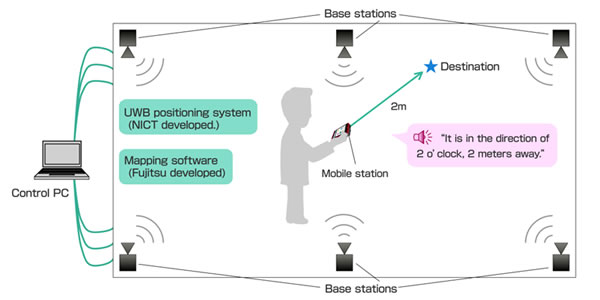
- The IR-UWB uses frequencies in the 7.25-10.25GHz band in Japan, the developed system has been certified by TELEC(4).
- The smartphone used is a Fujitsu-manufactured docomo NEXT series ARROWS X LTE F-05D released from NTT DoCoMo, and the mapping application was developed for Android 2.3.
Division of Responsibilities
With respect to the overall system, NICT developed the UWB positioning system and Fujitsu developed the mapping application for the smartphone.
Future Plans
NICT and Fujitsu plan to make further advancements to push forward the technology for assisting the blind by building a system with additional sensors that can detect obstacles on the road. Moreover, this highly precise positioning technology is notonly useful for the blind but also can be used to improve the safety of people in moving or to provide indoor guide services. For example, it could be used to guide visitors inside of local government buildings or hospitals to improve public safety and security. It could also be used in museums, libraries, and shopping malls, where contents could be tailored to a user's location. These are just a few of the comprehensive support service applications that could be developed to enhance user enjoyment and convenience.
For more information:
 Supplemental Materials [184KB / A4, 1 page]

-
[1] Ultra Wide Band (UWB) technology
UWB, which spreads electrical power over an extremely broad range of radio frequency, is a wireless technology using low power density for communications as well as for ranging and positioning applications. Because it uses low power and overlapped frequencies, it is attracting attention as a technology that can coexist with other wireless systems. UWB is generally divided into two frequency bands: UWB lower band (3.1-4.8 GHz, except in Japan, where it is 3.4-4.8 GHz) and UWB upper band (6.0-10.6 GHz, except in Japan, where it is 7.25-10.25 GHz).
-
[2] Impulse radio UWB (IR-UWB) technology
Impulse radio UWB technology is known for its ability of ranging with high precision. Within UWB, there is the impulse radio (IR) method and the multiband OFDM method. IR-UWB uses extremely short pulses on the order of nanoseconds. Because a nanosecond pulse provides very precise time resolution, ranging with an error of less than 30 centimeters is available by measuring the pulses. It is possible to raise theranging precision even further by taking some processing such as increasing the number of measuring before give a result.
-
[3] Smartphone mapping application
The application manages the UWB positioning system's mobile station and the smartphone's Bluetooth connection, and, based on the positioning data received from the mobile station, displays the current location on the screen and performs an audio reading of the location information.
-
[4] TELEC certification
Telecom Engineering Center (TELEC) provides certification for the use of UWB, such as the spectral density emission limit for UWB systems, the frequency band that is allowed to be used, and the minimum data rate. Only UWB systems that satisfy all the requirements in Japan's radio regulaionsare allowed to be used without a license. TELEC is an organization that verifies and certifies whether wireless systems conform with the radio regulations, and UWB systems receiving TELEC certification can be used without a license.
About Fujitsu
Fujitsu is the leading Japanese information and communication technology (ICT) company offering a full range of technology products, solutions and services. Over 170,000 Fujitsu people support customers in more than 100 countries. We use our experience and the power of ICT to shape the future of society with our customers. Fujitsu Limited (TSE:6702) reported consolidated revenues of 4.5 trillion yen (US$54 billion) for the fiscal year ended March 31, 2012. For more information, please see http://www.fujitsu.com.
About NICT
The National Institute of Information and Communications Technology (NICT) is the independent administrative agency of ICT in Japan. NICT promotes the full spectrum of research and development from basic to applied research with an integrated perspective, and thus promotes the advancement of Japan as an intellectual nation that leads the international community. Moreover, NICT forms close ties with the academic and business communities in Japan as well as with research institutes overseas and returns its R&D findings to society in a broad range of fields. For more information, please visit www.nict.go.jp/en/index.html.
Technical Contacts
Dependable Wireless Laboratory, Wireless Network Research InstituteHuan-Bang Li, Ryu Miura
 Phone: +81-468-47-5432
 E-mail: lee@nict.go.jp
E-mail: ryu@nict.go.jp
Company:National Institute of Information and Communications Technology
Press Contacts
Public Relations Department
Phone: 042-327-6923
E-mail: publicity@nict.go.jp
Company:National Institute of Information and Communications Technology
Android is a trademark of Google Inc. All company or product names mentioned herein are trademarks or registered trademarks of their respective owners. Information provided in this press release is accurate at time of publication and is subject to change without advance notice.
Date: 02 July, 2012
City: Tokyo
Company:
National Institute of Information and Communications Technology (NICT),
Fujitsu Limited,
,
,
,
,
,
,
,
,
