-
Sustainability at Fujitsu Group
-
Global Responsible Business
- Environment
-
- Environmental Management
- The Fujitsu Group Environmental Vision on Climate Change
- Living in Harmony with Nature (Conservation of Biodiversity)
- Environmental Action Plan
- Environmental Data
- Environmental Communication
- Environmental Social Activities
- Disposal and Recycling of ICT products
- Environmental Considerations in ICT Products
- Governance
-
Data and Documents
- Fujitsu Group Sustainability Data Book 2023
- Social, Governance and Environmental data
- Independent Assurance Report

- GRI Standards / United Nations Global Compact (UNGC) principles Comparison Table
- SASB Standards Comparison Table
- Sustainability Data Book Framework
- Link to regions responsible business reports
- Contact
- Sitemap
Sustainability Management in the Fujitsu Group
Policy, Promotion Scheme, and Review
The Fujitsu Group has always been seen by society as a trustworthy and responsible enterprise through its delivery of products and services. However, in the current era of VUCA(*1) we face major changes and the future is difficult to predict. It is therefore important that we, as a member of the global community, conduct business activities under the leadership of senior management that are aimed at resolving environmental, societal and economic problems and that will produce beneficial impacts for society. In April 2020, we established a Sustainability Management Committee that will drive a sustainability-focused management approach under the supervision and direction of the Board of Directors Meeting and the Executive Management Council Meeting. As of fiscal 2023, the committee is made up of members of the Board of Directors, including Representative Directors Mr. Tokita (Chairman), Representative Directors Mr. Furuta (Vice Chairman), and Director Mr. Isobe.
The objective of this committee is sustainability management that takes into account environmental, societal and economic impacts as well as stakeholder(*2) interests, ensuring that the company prospers in the long term as a responsible global enterprise. Specific initiatives will be in line with our values and our purpose, set out in the revised Fujitsu Way, and will include boosting our efforts in non-financial areas. These include respect for human rights, acceptance of diversity and equity, human resource development, maintenance of the global environment and contributing to the development of regional communities. Our goal is to achieve sustainable, long-term improvement in the corporate value of the Fujitsu Group.
The committee is scheduled to meet every six months, and on an ad hoc basis as required, to check on the progress of our activities in non-financial areas and to confirm and discuss if we are on track to meet our targets for the non-financial indicators. The committee will also discuss new activities, including in sustainability businesses, and then report to the Executive Management Council Meeting and the Board of Directors Meeting with the results. The committee is chaired by the CEO, who will nominate executives with a perspective on sustainability management for appointment as committee members. (As of May 2023, the committee had 13 members, including the chair.) The first committee meeting was held in April 2020, followed by semiannual meetings – with the most recent meeting held in March 2023. To date, the meetings have been characterized by lively discussions on topics such as the COVID-19 pandemic, the accelerating global movement toward carbon neutrality , the ideal future shape of the Fujitsu Group, the mission of the committee, details of the non-financial indicators, an overview of Global Responsible Business activities and progress toward achieving the related targets.
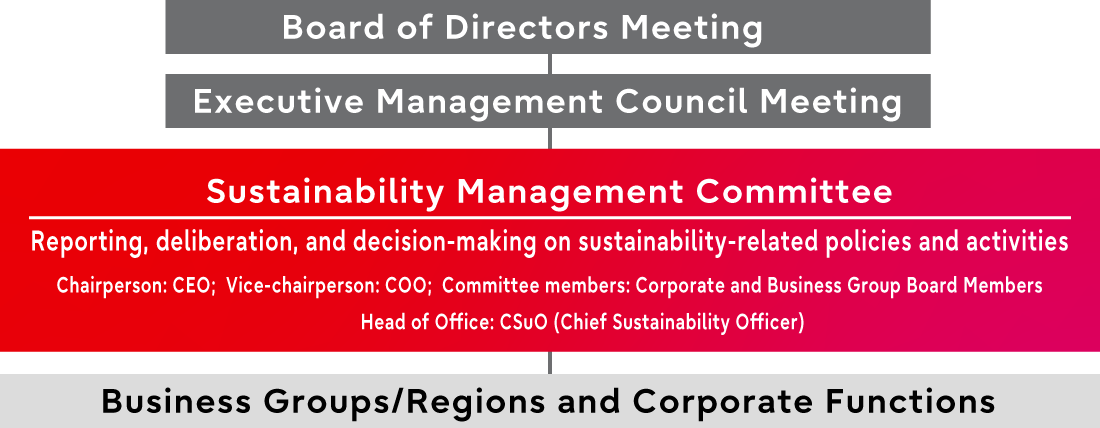 System Chart
- (*1)VUCA: Volatility, Uncertainty, Complexity, Ambiguity
- (*2)The Fujitsu Group’s stakeholders: The Fujitsu Group regards our people, customers, partners, community and shareholders as its stakeholders. Government authorities, NPOs, NGOs, and similar organizations are also particularly important stakeholders within this community.
Global Responsible Business
Since its CSR Promotion Committee established the Basic Strategy Working Group in 2010, the Fujitsu Group has identified Five Priority Issues in its Basic CSR Policy and has been promoting activities that address those priority issues. The working group conducted interviews with outside experts regarding the expectations and demands on Fujitsu, based on an awareness of global CSR standards and social issues.
However, recent years have seen a further ramping up of demand for initiatives aimed at responding to challenges on a global scale, including the adoption of the Sustainable Development Goals (SDGs) by the United Nations and the coming into effect of the COP 21 Paris Agreement related to climate change. The Fujitsu Group has employed a materiality analysis in a Groupwide review of the priority issues to ensure that they reflect changes in its business over the past several years. The result was the establishment of a unified framework for the priority issues under the new name of Global Responsible Business (GRB).
Global Responsible Business
The GRB framework aims to foster the mindset and corporate culture necessary to realize the Fujitsu Way by engaging in specific activities that address our priority issues and to earn and maintain the social trust that is a prerequisite for global business activities. All Group employees must be constantly aware that their companies are part of society and aim to not only pursue profits but also reduce the negative impact of their business activities on sustainability issues while maximizing the positive.
To achieve these objectives, we specified goals for each priority issue with March 2023 set as the deadline for achievement and we have been engaged in a range of activities. We have set new goals with a deadline of March 2026 and, in order to carry out higher-level activities globally while taking into account the differences between countries and regions in such areas as local laws and labor markets, we have set Groupwide targets for all employees. Employees based at our headquarters who are responsible for each of the priority issues led efforts in formulating these targets, while personnel in overseas regions with similar responsibilities also provided input in this regard. We will continue to work on specific measures toward achieving the goals.
Raising Awareness and Disseminating Information Internally and Externally
To realize our corporate purpose, we engage in businesses that have a beneficial impact on resolving challenges in society, and to conduct our operations in a responsible manner throughout all business activities, we are implementing a range of measures to raise awareness and enhance our employees’ understanding of GRB. In addition, we disseminate information outside the company to convey to stakeholders the Fujitsu Group’s position on sustainability management and related initiatives.
- At internal and external events and presentations, we introduce the non-financial framework around Fujitsu’s sustainability management and explain how an executive leader has been appointed for each of the priority issues as we implement initiatives on a global basis.
- Employee understanding is further enhanced through our intranet sites in Japanese and English, which are updated as required by GRB operations staff.
- We published a series of 10 articles in Fujitsu’s in-house magazine, in both Japanese and English, featuring overviews of each of the priority issues as well as specific initiatives. A survey conducted on this series revealed that approximately 90% of those who read the articles responded that they developed a deeper understanding of GRB, while around 60% stated that they had changed their way of thinking and behavior. This illustrates the link to improved understanding and empathy.
- We conduct employee awareness surveys in relation to sustainability and utilize the responses when planning and implementing internal and external initiatives.
- In terms of business involvement, we incorporate the GRB perspective in our proposal process to help our customers solve their sustainability-related management issues. Contents on GRB initiatives such as environment and wellbeing are included in the proposal materials provided to customers, as we work to promote further usage and deployment in frontline business interactions.